

“We’re looking for a speaker on taboos, but you do have to watch what you say.”
“I understand. How open do you want me to be?” I ask over the phone.
The line goes quiet for a moment. “Well… just. Open. But you should know that…”
We share a laugh about what feels uncomfortable within the organization. Everyone wants openness, but no one wants to drop the bombshell. After two years, I effortlessly weave taboos into my keynote: medical taboos & management taboos. Menopause? Fine. Burnout? No problem.
But societal taboos? Those are trickier. You can feel the discomfort before you even start speaking. These are the three taboos I’ve chewed on the most.
The political taboo: Can right and left work together?
In the pub, we can tolerate it from each other; at family gatherings, we try to avoid it; but in the workplace? There, we pretend politics doesn’t exist. Even though it’s always there.
The divide has become sharp: in the Netherlands, in Belgium, in the United States, … everywhere. We all develop viewpoints on climate, migration, social policy, … We attach our viewpoint to our identity or worse: our viewpoint becomes our identity. “How can you think that?” turns into: “Who are you, really?”, “Do I have to work with someone like you?” But we also very often wisely hold our tongues: we whisper in the corridors about “that leftist rat with her diversity” or “that selfish jerk voting for Wilders.”
Yet people with opposing worldviews must work together. Working toward the same goal, for the same client. The question isn’t whether right and left can work together, but how we do it without the coffee machine becoming a battlefield.
If you are aware that your political stance makes your colleague uncomfortable, the best solution is to prioritize the goal of the collaboration. Openness.
A beautiful campaign by Heineken, “Worlds Apart,” highlights this: Heineken – Worlds Apart, #OpenYourWorld (2017)
The realization that you don’t have to agree to work together, but daring to name it: that’s where it starts. If politics stands in the way of collaboration, do we dare to make politics discussable without losing each other?
2. Debt: Is it your fault?
Taboos have a major common denominator: isolation. Debt is a very striking example of this. Money, possessions, wealth… we stay silent about what we have to avoid jealousy or envy. Many fairy tales and religious stories point us to the dark side of greed and success. Social media is full of success stories. Money problems are the taboo that always comes with a sense of guilt. Whoever has debt has done something wrong. A bad decision, spent too much, saved too little.
Would you dare to let someone who can’t manage their own money manage your budget?
During an event about debt, a lot became clear to me. Debt is a consequence of silence. It starts small, €100, but if you don’t have that €100, it quickly grows. In fact, it keeps mounting until you can no longer keep it a secret.
But what if your divorce swallowed half your income? What if your healthcare costs became sky-high? What if you simply couldn’t escape the reality you were born into?
Debt remains one of the biggest stressors in the workplace. People worry, sleep poorly, make mistakes, and call in sick more often. Yet it remains quiet. No one labels “financial worries” as the reason for their sick leave; it’s not sickness absence, it’s silence absence.
But what if your divorce swallowed half your income? What if your healthcare costs became sky-high? What if you simply couldn’t escape the reality you were born into? What if you just like taking risks, like winning big or losing big?
For debt, reframing the taboo is very important. Is it the result of a struggle with a noble goal?
Debt, however, remains one of the biggest stressors in the workplace. People worry, sleep poorly, make mistakes, and call in sick more often. Yet it remains quiet. No one labels “financial worries” as the reason for their sick leave. Employers, however, can easily help: an advance, a loan, a financial advisor… There are numerous ways to help and give your employee an unprecedented experience as a company.
But first, you have to have the conversation.
3. Grief: How long is sorrow allowed to last?
The grief protocol in most workplaces is clear: three days of leave, a bouquet of flowers, a sympathetic email. After that? Back to work.
Grief, however, is not a task on a checklist. Not a virus that you get over after a week. It is a damn long shadow that doesn’t stick to office hours.
Through a colleague, I was introduced to the books of Manu Keirse. What an incredibly inspiring man! No one has explained grief to me so well. Before that, my knowledge of “grief” was also particularly limited. Limited to the funeral: bury it and move on.
In my entire professional career, I have probably sinned most against “grief.” I treated it as a private matter that I couldn’t change. So why would you bother me with it?
Grief has no deadline. Grief is also broader than the loss of a loved one. And what I learned about grief has taught me to listen better to patients.
After every keynote, I drive home and remember the faces in the room. The man in the front row who crossed his arms during the political taboo. The woman who nodded during the part about the wage gap and financial independence. The colleagues who shared a look during the segment on grief.
Often someone approaches me afterward: “thank you.” Sometimes a message via LinkedIn: “spent the whole evening talking it over with my wife.” But usually, the looks say enough.
Every time I speak, everyone seems to be looking for the space to show their taboo.
Is your organization also struggling to have difficult conversations? Give your colleagues a nudge and organize a keynote on the impact of taboos!
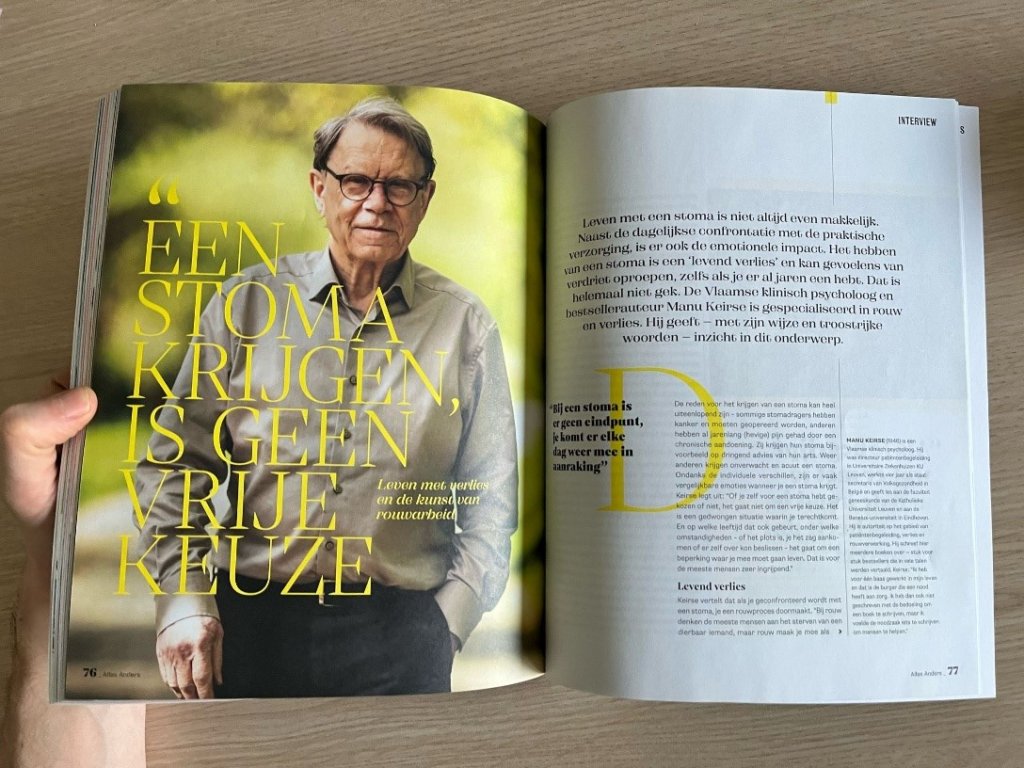
Photo: Manu Keirse in the magazine Alles Anders, 2024